Posts

Judge Walter Irvine

Image
Record of the Month! For the month of October we are featuring a Spooky Story from the Stacks, starting with the unfortunate tale of Licking County Probate Judge Walter A. Irvine. Judge Irvine’s story begins innocently enough, though it takes dark and tragic turns. On display are reproductions of various records documenting Judge Irvine’s story.   Walter A. Irvine was born in Pennsylvania on October 6, 1867 to Thompson and Elizabeth Irwin. Just before 1880, the Irwin family moved to Newark, Ohio, where Thompson Irwin had secured a job as a round house foreman on the railroad. In 1887, Walter joined Company G of the 17 th Regiment Ohio National Guard as a Private. The following year he was promoted to Corporal, a rank he did not hold long. The units were reorganized late in 1888 and Walter received another promotion. Skipping a few ranks, the freshly minted Captain Walter Irvine was placed in charge of the new Newark Guard’s Regiment, Company G. Walter also pursued a de...

Preserved Last Wills

Image
Record of the Month! For the month of September, we are excited to feature two very rare will records dated prior to the 1875 Courthouse fire that have been recently discovered in the stacks. Left: The Last Will and Testament of James Tartton, Signed July 19, 1851. Right: The Last Will and Testament of Henry Wimer, Signed May 22, 1858. In 1831 the County built its’ first large stone courthouse in the center of the square, replacing 2 smaller log cabins. The courthouse stood for 44 years, before a mysterious fire reduced it to smoldering ruins in early hours of April 3 rd 1875. Sadly, the fire destroyed an estimated 2,500 boxes of early county and probate court records, making probate records prior to 1875 very rare. The first will to be discovered was written by James Tartton on July 19, 1851. From this document we know that James was a farmer, his wife was Elizabeth Tartton and they had two sons named James Meriett and Washington Vanburen. We also know that James had...

OHRAB Grant Update - Cleaning Historic County Records

Image
In June the Records Center was awarded an OHRAB grant to purchase supplies for the purpose of cleaning historic county records, which were previously stored in the county’s courthouse attic. The records range several departments including the Clerk of Courts, Auditor, Treasurer, and Recorder, and date back to the early 1800s. There are roughly 300 books that will be cleaned, cataloged, and stored at the Records Center. Last week while cleaning, staff member Sophia came across the oldest book in the bunch so far: an 1834 real estate duplicate. As you might imagine, this book had a substantial amount of dust on it, being 185 years old. It’s possible that this book was placed in the courthouse attic any time after 1876, when the courthouse was rebuilt after the infamous 1875 courthouse fire, and hadn’t been moved since. In fact, it was impossible to even read the titled on it until it was vacuumed due to the thick layer of dust that had settled. The book provides a glimpse into ...

Great Seal of the State of Ohio

Image
Record of the Month This month we are featuring records sealed with the Great Seal of the State of Ohio. The Great Seal of the State of Ohio Today the Great Seal of Ohio is the official signature of the state and of her government. In 1802, during the Ohio territory’s bid for statehood, Ohio’s constitutional delegates stipulated that the governor was to keep the Great Seal of the State of Ohio and that it was to be affixed to all official documents. As with all signatures, the Great Seal of the State of Ohio has changed multiple times over the last 216 years. Despite the changes, the general imagery of the Seal has stayed fairly consistent, featuring a sun rising over hills, a river, and a valley, along with a bundle of 13 arrows and a bundle of wheat standing in the front. From 1847 to the early 1900s, the Official Seal used by the governors featured a canal boat, which was a prominent mode of transportation for the state. However, throughout the 19 th Century there w...

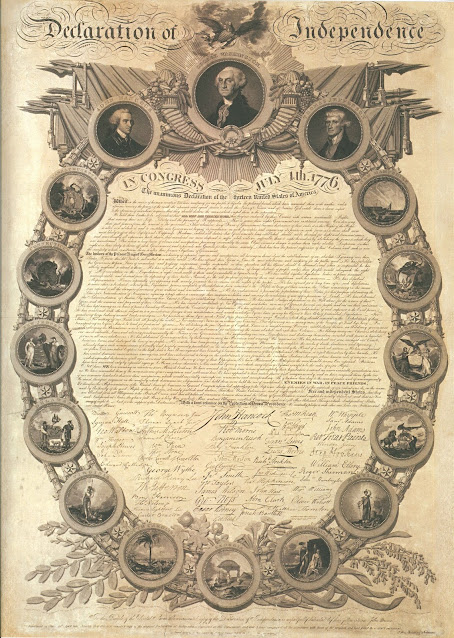
Declaration of Independence

Image
Record of the Month! To celebrate Independence Day, this month we are featuring a reproduction of the Declaration of Independence. While the Declaration of Independence is not part of the Licking County Records & Archives’ collection of historic county records, it had a strong influence on the establishment of Licking County’s government in 1808, as well as the laws and policies that would ultimately lead to the creation of the Licking County Records & Archives Center in 2008.    Of the many principles outlined in the Declaration, none is more fundamental than that of a free and open government. Public records protect the rights of citizens by empowering them to hold their government accountable and enabling them to make informed decisions. One of the complaints against King George III of Great Britain named by the Founding Fathers was the following: He has called together Legislative Bodies at places unusual, uncomfortable, and distant from the depos...

Historical Paper

Image
Record of the Month! This month we are featuring the types of paper that can be found in the Licking County Records & Archives Center. Today as our digital society moves more towards paperless everything, it is easy to forget that paper and its production were revolutionary technological breakthroughs. In fact, the various techniques used to manufacture high quality paper were closely guarded secrets among tradesmen for centuries. Prior to paper and paper-like substances, people would record all manner of things by carving stone, bones and clay tablets. Paper as we define it today is made from macerated or water softened fibers, which are pressed together to make a thin continuous sheet. The first paper-like substances were papyrus and rice paper, however due to how these materials are produced they are not considered true paper. Papyrus is made out of thin reeds that are cut and “laminated” together with paste. Rice paper is not actually paper, but thin spirally cut ...

Newark-Granville Electric Street Railway Company Bond

Image
Record of the Month! This month we are featuring an 1888 investment bond from the Newark-Granville Electric Street Railway Company. In the latter 19 th Century the United States was a burgeoning electric power. The electric light bulb, invented in 1878 by Ohioan Thomas Edison, was slowly becoming more mainstream, along with a range of other electrically powered devices. One industry that jumped at the new technology was transportation. Railways were on the rise due to their comfort and speed for long-distance travel. Horse drawn streetcars (or trollies) were the primary form of public transportation for more local travel. On December 28, 1889, a new electric streetcar began its seven mile route from Newark to Granville. As a result, Ohio became one of the first states in the Union to have an interurban electric streetcar. Today there is some debate among historians as to whether or not the the Newark-Granville line can be rightfully called the first interurban route ...